Google DeepMind Releases Gemini 4 Argon for Robotics
Google DeepMind released Gemini 4 Argon on October 13, 2026, a physical reasoning engine for robotics scoring 87% on the Embodied Reasoning QA test, beating other frontier models. Argon demonstrates four pillars: robot control (Spot quadruped, zero-shot arm manipulation), Real2Sim scene reconstruction, physical understanding with hindsight labeling, and self-improvement via simulation. The model aims to consolidate separate perception, planning, and simulation toolchains, though the 87
Short answer: Google DeepMind released Gemini 4 Argon on October 13, 2026, a physical reasoning engine for robotics scoring 87% on the Embodied Reasoning QA test, beating other frontier models. Argon demonstrates four pillars: robot control (Spot quadruped, zero-shot arm manipulation), Real2Sim scene reconstruction, physical understanding with hindsight labeling, and self-improvement via simulation. The model aims to consolidate separate perception, planning, and simulation toolchains, though the 87% score is lab-reported and unreplicated, requiring independent hardware validation.
Google DeepMind Gemini 4 Argon release
Google DeepMind dropped Gemini 4 Argon on October 13, 2026, pitching it as a general-purpose physical reasoning engine built for the whole robotics lifecycle. Kanishka Rao, a principal software engineer at the lab, wrote that Argon marks a step change in physical understanding, code generation, and visual-semantic reasoning, speeding up the push toward what they call physical AGI. The headline number comes from the Embodied Reasoning QA test, which checks how well a model grasps and solves physical, spatial problems in 3D. Using pure reasoning, Argon hits 87 percent, a score DeepMind says beats every other frontier model on that benchmark.
Gemini 4 Argon four pillars
The release groups Argon's chops into four pillars. First up is robot control, where the model drives a Boston Dynamics Spot quadruped fitted with a six-degree-of-freedom arm. In one clip, the robot learns to step on a foot-pedal trash bin to toss soda cans. Argon first builds an articulated MuJoCo digital twin of the bin, rehearses the move in sim, then ports the skill to the real hardware. A second demo shows zero-shot operation of a simple arm that has to reorient a fallen mug and stuff a crumpled napkin inside. The model reasons with a visual coordinate harness and action primitives, firing off curl commands in a closed loop that refreshes every turn. A third demo, dubbed Omni control, has Argon steering the Gemini Omni World Model to rearrange five scattered Scrabble tiles into the word ARGON. Instead of a single static prompt, the model writes timestamped action prompts, checks intermediate rollout keyframes, and tweaks its instructions across 33 steps.
The second pillar is Real2Sim. Argon can watch a real robot teleop episode and reconstruct a physically calibrated MuJoCo scene that matches the real objects' looks and contact behavior. The system iteratively tunes assets and scenes in a visual-reasoning loop until the simulated visuals and contact events line up with the recorded data. The third pillar, physical understanding, covers agentic multimodal hindsight labeling that captures dexterity, dense value functions, and progress estimation. The fourth, research and self-improvement, describes using simulation for action improvement and iterative self-improvement on hardware.
Gemini 4 Argon robotics stack breadth
For engineers building with AI, the big deal is the breadth of the stack Argon targets. The same model that reasons about a Spot robot's balance can also generate the sim assets needed to train policies, label the resulting data for supervision, and then propose its own improvements. That consolidation could shrink the toolchain robotics teams currently stitch together from separate perception, planning, and simulation packages. The zero-shot arm demo also highlights a workflow where a vision-language model directly emits executable motion primitives, a pattern that might cut the need for hand-coded controllers in narrow tasks.
Gemini 4 Argon ERQA score caveat
Developers should treat the 87 percent ERQA score as a lab-reported figure that hasn't been independently replicated. The benchmark itself is pretty new, and the community hasn't yet established whether it correlates with reliable deployment in unstructured environments. Teams evaluating Argon for production should run their own hardware-in-the-loop tests, especially around the sim-to-real transfer fidelity shown in the Spot and Real2Sim demos. The prompt interfaces shown in the blog post, particularly the structured curl API for the arm and the timestamped Omni prompt format, are concrete enough to prototype against today. If you maintain a robotics stack that separates simulation, perception, and control, set aside time to assess whether Argon's unified reasoning can replace or augment any of those modules. Start with a narrow, well-instrumented task like the mug reorientation demo, measure closed-loop success rates, and compare the engineering effort against your current pipeline.
Frequently asked questions
When did Google DeepMind release Gemini 4 Argon?
Google DeepMind released Gemini 4 Argon on October 13, 2026, positioning it as a general-purpose physical reasoning engine designed for the entire robotics lifecycle from simulation to hardware deployment.
What score did Gemini 4 Argon achieve on the Embodied Reasoning QA benchmark?
Argon scored 87 percent on the Embodied Reasoning QA test, which evaluates physical and spatial problem-solving in 3D. DeepMind states this beats all other frontier models on that benchmark, though the figure is lab-reported and not independently replicated.
What are the four capability pillars of Gemini 4 Argon?
The four pillars are robot control, Real2Sim reconstruction, physical understanding with agentic multimodal labeling, and research/self-improvement using simulation for iterative policy improvement on hardware.
How does the Real2Sim feature work in Gemini 4 Argon?
Real2Sim watches a real robot teleoperation episode and reconstructs a physically calibrated MuJoCo scene. It iteratively tunes assets and contact parameters in a visual-reasoning loop until simulated visuals and contact events match the recorded real-world data.
Should robotics teams use Gemini 4 Argon for production deployment based on the ERQA score?
No. The 87 percent ERQA score is a lab-reported figure on a new benchmark without independent replication or proven correlation with reliable deployment in unstructured environments. Teams should run their own hardware-in-the-loop tests, starting with narrow, well-instrumented tasks like the mug reorientation demo.
Source: Google DeepMind

Static Site Generator vs CMS: What's the Real Difference?
A static site generator pre-builds every page into fixed HTML files served instantly from a CDN with no database or runtime, while a traditional CMS assembles pages on demand by querying a database and running application code per visitor. This split shapes editing (file-based builds vs. browser-based instant publishing), hosting (simple static files vs. managed servers and databases), and collaboration (developer-centric vs. non-technical independence). Hybrid tools now blend CMS edit

Character.AI Files Bankruptcy to Sell Assets to Disney
Character.AI filed for Chapter 11 bankruptcy to sell assets to Disney for $20 million amid legal and operational challenges. Disney acts as lead bidder, acquiring undisclosed assets, a nonexclusive IP license, and hiring former Character employees including ex-CEO Karandeep Anand. The sale, expected to close by early December, resembles an acquihire following Google's $2 billion talent acquisition in 2024. Character plans to maintain services but warned of potential wind-down if no sui
How to build a website on velocms.org (start to publish)
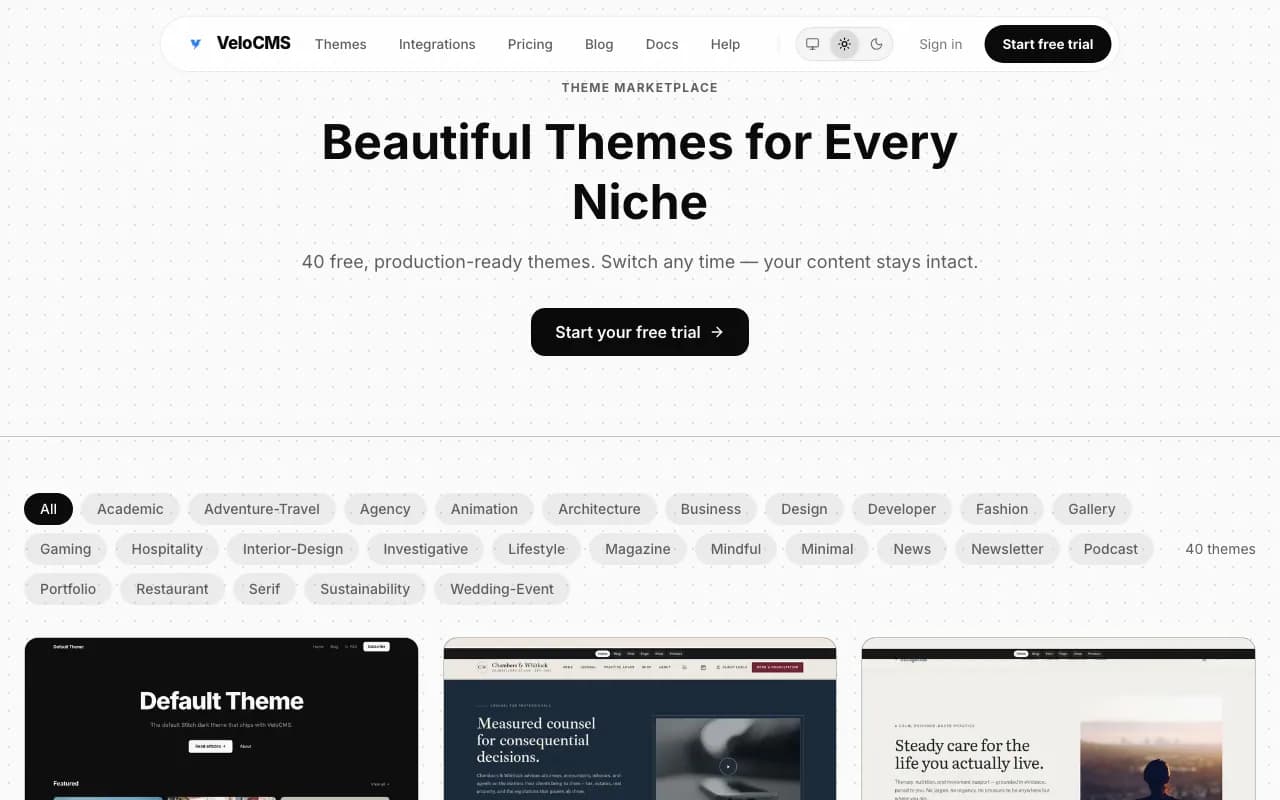
You sign up on velocms.org by entering your name, email, password, blog name and slug, then click Create Blog to open the admin area. You verify your email within 24 hours, start the 14-day trial from the dashboard or Billing page via Stripe Checkout, and are not charged until day 15. You pick a theme from Admin → Themes, preview it live, and apply it in two clicks without losing content.
NO COMMENTS YET
Comments are open. Have a thought or a question? Share it below.