Character.AI Files Bankruptcy to Sell Assets to Disney
Character.AI filed for Chapter 11 bankruptcy to sell assets to Disney for $20 million amid legal and operational challenges. Disney acts as lead bidder, acquiring undisclosed assets, a nonexclusive IP license, and hiring former Character employees including ex-CEO Karandeep Anand. The sale, expected to close by early December, resembles an acquihire following Google's $2 billion talent acquisition in 2024. Character plans to maintain services but warned of potential wind-down if no sui
Short answer: Character.AI filed for Chapter 11 bankruptcy to sell assets to Disney for $20 million amid legal and operational challenges. Disney acts as lead bidder, acquiring undisclosed assets, a nonexclusive IP license, and hiring former Character employees including ex-CEO Karandeep Anand. The sale, expected to close by early December, resembles an acquihire following Google's $2 billion talent acquisition in 2024. Character plans to maintain services but warned of potential wind-down if no suitable bid emerges.
Character AI Chapter 11 Bankruptcy Disney Sale
Character.AI has filed for Chapter 11 bankruptcy protection and agreed to sell portions of its business to Disney, marking a dramatic turn for one of the generative AI boom's earliest breakout startups. The company announced the move in a press release and blog post published Monday, saying it took the step to facilitate a sale after what it described as significant legal, regulatory, and operational headwinds over the past year.
The bankruptcy filing lists estimated liabilities between fifty million and one hundred million dollars. Under the proposed arrangement, Disney will act as the lead bidder, establishing a floor for any competing offers. Disney will pay twenty million dollars for certain undisclosed assets and provide transition support using former Character employees it has already hired. The entertainment giant will also receive a nonexclusive license to unspecified intellectual property.
Disney Hires Character AI CEO Karandeep Anand
Disney's involvement follows its recent hiring of Karandeep Anand, who served as Character's chief executive for just over a year before joining Disney as chief technology officer. During Anand's tenure, Character pushed into microdramas, a format that blends short-form storytelling with interactive chat. Disney had previously complained that Character was damaging its brand and exploiting its intellectual property by allowing unauthorized chatbots based on Disney characters, prompting the company to send cease-and-desist letters.
Along with Anand, Disney said it expects a number of Character's technical team members to join its ranks. The structure resembles an acquihire, a tactic that has grown common in Silicon Valley as large companies absorb startup talent while the original business struggles to survive. Character has already weathered one such event: in 2024, Google spent more than two billion dollars to hire away much of the company's talent, including co-founders Noam Shazeer and Daniel De Freitas.
Character says it expects the sale process to conclude by late November or early December and plans to keep its services running, including paid subscriptions, in the meantime. The company warned, however, that the platform will be wound down if a suitable bid fails to materialize. It added that maintaining a safe and engaging experience for its community remains a top priority as it navigates the process.
Generative AI Competitive Landscape Shifts
For builders and users of AI, the filing underscores how quickly the competitive landscape can shift. Character.AI attracted a devoted user base with its roleplay-focused chatbots, but the company faced mounting lawsuits and scrutiny over safety concerns tied to its open-ended conversational models. The legal pressure, combined with the high cost of running large language models at scale, appears to have made the standalone business unsustainable even after Google's earlier talent acquisition injected significant capital.
The Disney deal also signals how major media companies are approaching generative AI: not by building from scratch, but by absorbing specialized teams and licensing technology that can be integrated into existing franchises. Disney's strategy suggests it wants the engineering talent and the underlying conversational architecture more than the consumer-facing brand itself.
Character AI API Developer Migration Guide
Developers who have built applications on top of Character's API or who rely on its platform for community features should monitor the sale timeline closely. If the transaction closes as expected in late November or early December, the terms of service and API access could change under new ownership. Anyone operating a production dependency on Character's infrastructure should have contingency plans ready, including alternative model providers or self-hosted options, in case the platform is wound down or its APIs are deprecated.
More broadly, the episode illustrates that even early movers with strong user engagement can falter when safety liabilities and compute costs outpace revenue. Startups in the consumer AI space should treat trust and safety investment as a core operational expense rather than an afterthought, and they should model runway scenarios that account for potential litigation costs. For enterprise buyers, the acquihire pattern means that vendor stability cannot be assumed based on funding headlines alone; the talent may stay, but the product roadmap can change overnight.
Frequently asked questions
Why did Character.AI file for Chapter 11 bankruptcy?
Character.AI filed for Chapter 11 to facilitate a sale of its assets after facing significant legal, regulatory, and operational headwinds, including mounting lawsuits over safety concerns and the high cost of running large language models at scale, which made the standalone business unsustainable.
What is Disney paying for Character.AI's assets?
Disney will pay $20 million for certain undisclosed assets, provide transition support using former Character employees it has already hired, and receive a nonexclusive license to unspecified intellectual property as the lead bidder in the bankruptcy sale.
When is the Character.AI sale expected to close?
Character.AI expects the sale process to conclude by late November or early December 2025, though the platform will be wound down if a suitable bid fails to materialize.
What happens to Character.AI's services and subscriptions during the bankruptcy?
Character.AI plans to keep its services running, including paid subscriptions, during the sale process, but warns the platform will be wound down if a suitable bid does not emerge.
How does this affect developers using Character.AI's API?
Developers relying on Character.AI's API or platform should monitor the sale timeline closely, as terms of service and API access could change under new ownership, and should prepare contingency plans including alternative model providers or self-hosted options.
Source: The Verge
Static Site Generator vs CMS: What's the Real Difference?
A static site generator pre-builds every page into fixed HTML files served instantly from a CDN with no database or runtime, while a traditional CMS assembles pages on demand by querying a database and running application code per visitor. This split shapes editing (file-based builds vs. browser-based instant publishing), hosting (simple static files vs. managed servers and databases), and collaboration (developer-centric vs. non-technical independence). Hybrid tools now blend CMS edit
Google DeepMind Releases Gemini 4 Argon for Robotics
Google DeepMind released Gemini 4 Argon on October 13, 2026, a physical reasoning engine for robotics scoring 87% on the Embodied Reasoning QA test, beating other frontier models. Argon demonstrates four pillars: robot control (Spot quadruped, zero-shot arm manipulation), Real2Sim scene reconstruction, physical understanding with hindsight labeling, and self-improvement via simulation. The model aims to consolidate separate perception, planning, and simulation toolchains, though the 87
How to build a website on velocms.org (start to publish)
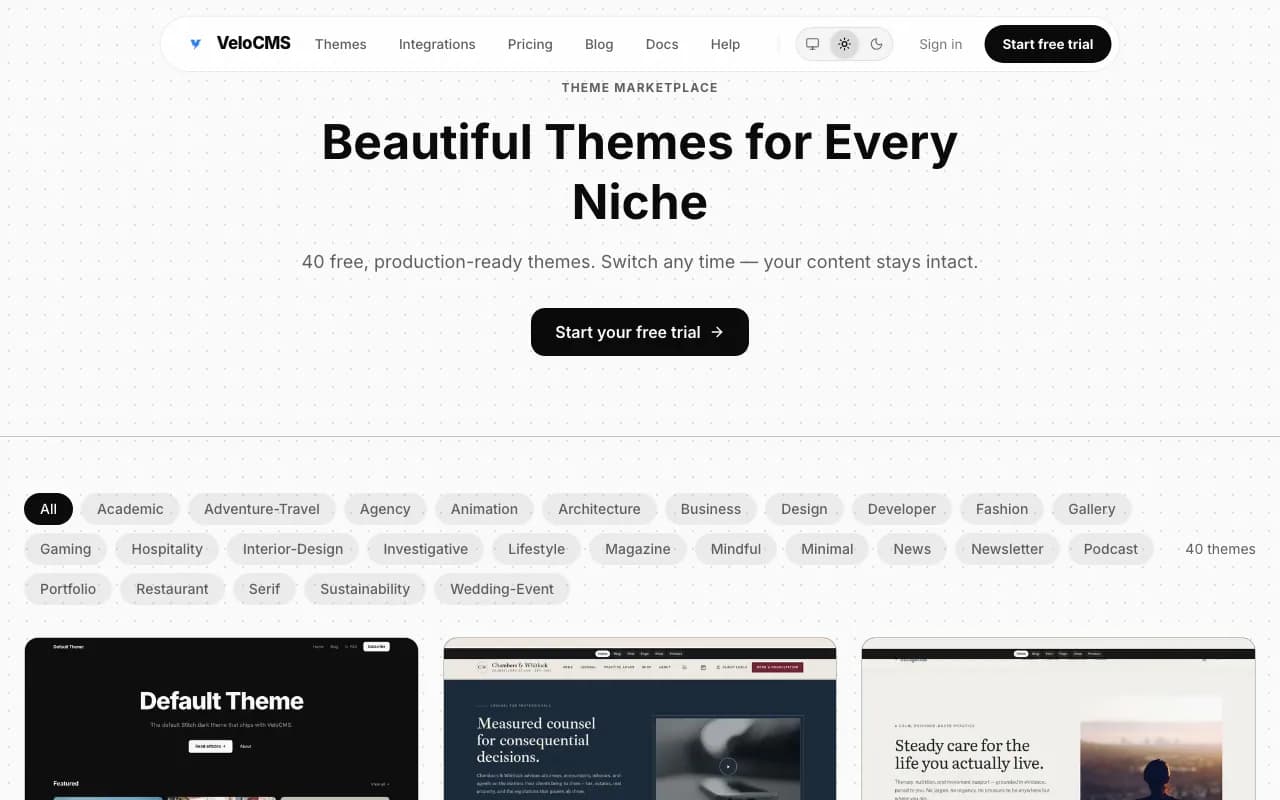
You sign up on velocms.org by entering your name, email, password, blog name and slug, then click Create Blog to open the admin area. You verify your email within 24 hours, start the 14-day trial from the dashboard or Billing page via Stripe Checkout, and are not charged until day 15. You pick a theme from Admin → Themes, preview it live, and apply it in two clicks without losing content.
NO COMMENTS YET
Comments are open. Have a thought or a question? Share it below.